From diode pump modules to coherent beam combining, every optical subsystem in a Lumentum laser originates from our in-house photonics development. This page details the core technologies that differentiate our platforms from assembled-from-catalog competitors.
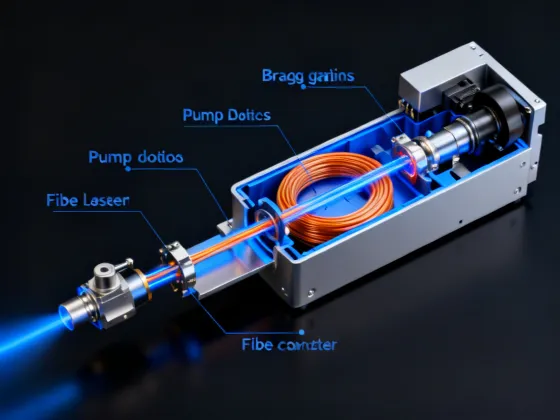
Unlike system integrators who source laser oscillators from third-party OEMs, Lumentum manufactures its fiber laser resonators in-house. The process begins with custom fiber Bragg grating (FBG) writing using our phase-mask exposure system, achieving reflectivity control to within 0.1dB. Active fiber is fusion-spliced to pump combiners in a Class 100 cleanroom environment, resulting in oscillators with electrical-to-optical efficiency exceeding 45%.
This vertical integration means we can tune center wavelength (1060nm to 1080nm), linewidth, and temporal characteristics to match specific material processing requirements rather than offering a one-size-fits-all oscillator.
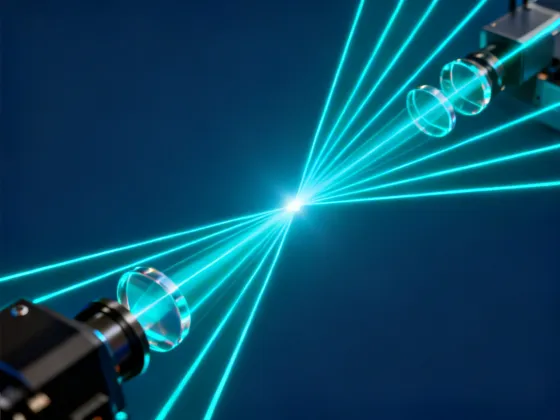
High-power fiber lasers face a fundamental physics constraint: single-mode fibers exhibit stimulated Raman scattering (SRS) and transverse mode instability (TMI) at power levels above 3-4kW. Lumentum's coherent beam combining technology addresses this by phase-locking multiple single-mode oscillators and combining them into a single, near-diffraction-limited output beam.
Our CBC architecture uses a proprietary phase detection and feedback system operating at 100kHz bandwidth to maintain coherent lock despite thermal and mechanical perturbations. The result is a 20kW beam with M-squared below 1.3 that can be delivered through a 100-micron process fiber, enabling cutting speeds and edge quality that multi-mode fiber lasers at equivalent power cannot match.
Limitation: CBC systems require a 15-minute thermal stabilization period at startup. Performance specifications quoted are achieved after this warm-up cycle. Cold-start beam quality is typically M-squared 1.5-1.8.
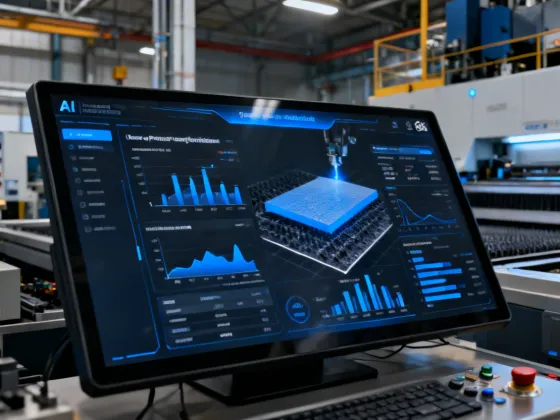
Introduced in 2025, our LaserIQ platform uses a convolutional neural network trained on 2.3 million cutting records across 47 material grades to recommend initial cutting parameters within 90 seconds of material identification. The system ingests coaxial camera data, acoustic emission signals, and back-reflection measurements to continuously refine feed rate, focal position, and gas pressure during production runs.
In controlled testing at a tier-1 automotive supplier, LaserIQ reduced parameter setup time by 72% and improved first-part-good rate from 84% to 97% when switching between dissimilar materials. The system requires an initial calibration dataset of at least 50 cuts per material grade to achieve full accuracy.
Note: LaserIQ currently supports cutting applications only. Welding and marking parameter optimization modules are in development and expected for release in Q3 2026. Accuracy figures are from controlled testing conditions; production environment results may vary based on material lot consistency and ambient temperature stability.
Every Lumentum system undergoes a multi-stage optical verification process using NIST-traceable instrumentation.
Each pump diode module is wavelength-verified, power-mapped, and thermal-cycled 500 times before oscillator integration. Modules falling outside ±0.5nm of target wavelength are rejected.
Fiber splicing is performed in a Class 100 cleanroom using automated alignment stages. Each splice is tensile-tested to 3N minimum pull strength. Oscillator cavity finesse is measured using a scanning Fabry-Perot interferometer.
Output beam is measured using a Spiricon M-squared analyzer at 10%, 50%, and 100% power. Far-field divergence, beam pointing stability, and polarization extinction ratio are documented for every unit.
Complete system undergoes a 47-point inspection including servo tuning verification via laser interferometer, safety interlock functional testing, and 24-hour burn-in at rated power before shipping.
Selecting between fiber and CO2 laser sources requires evaluating material absorption, beam delivery constraints, and total cost of ownership.
| Parameter | Fiber Laser (1070nm) | CO2 Laser (10600nm) |
|---|---|---|
| Wall-plug efficiency | 40-50% | 10-15% |
| Beam delivery | Flexible fiber (no mirrors) | Mirror-based articulated arm |
| Highly reflective metals (Cu, Al, Brass) | Good absorption at 1070nm | Poor absorption, back-reflection risk |
| Thick acrylic/wood | Poor cut quality (charring) | Excellent edge quality |
| Maintenance interval | 50,000+ hrs (diode life) | 2,000-4,000 hrs (gas refill, mirror cleaning) |
| Thin metal (<3mm) cutting speed | 2-5x faster | Baseline |
| Initial acquisition cost (6kW) | $180K - $350K | $250K - $500K |
Table represents general industry parameters and may vary by manufacturer. CO2 lasers remain the preferred choice for non-metallic materials including acrylic, wood, textiles, and certain plastics. Lumentum recommends CO2 systems for these applications and can refer qualified CO2 laser partners.
Lumentum reinvests 14% of annual revenue into photonics research and development, funding active programs in next-generation beam combining, ultrafast laser pulse shaping, and AI-based process control.
Whether you need help selecting a wavelength for a new material, optimizing an existing cutting process, or evaluating whether fiber laser technology is appropriate for your application, our photonics engineers are available for technical consultations.
Request a Technical Discussion